As-built documentation is often treated as a final project phase. Near practical completion, teams begin collecting mark-ups, photographs, test records, equipment details and outstanding model changes to assemble the handover record.
By then, much of the information is already difficult to verify.
The people who made a site decision may have moved to another package. Temporary mark-ups may be incomplete. Several revisions may describe the same area differently. Installed equipment may not match the design-stage selection, and concealed work may no longer be visible.
The result may satisfy a deliverable checklist while still leaving the owner uncertain about what was actually built.
A more reliable approach is to maintain the as-built record from the beginning of construction. Changes are captured as part of the regular project workflow, while the work and its supporting evidence are still available.
The Cost of Reconstructing the Record
Rebuilding project information at the end creates work that could have been completed in smaller, controlled updates during delivery.
The handover team may need to:
- review months of RFIs, site instructions and design changes;
- compare multiple drawing and model revisions;
- trace marked-up documents back to approved decisions;
- inspect completed areas to confirm what was installed;
- request missing product and asset information from subcontractors;
- reconcile equipment schedules with labels found on site;
- survey or scan concealed and inaccessible conditions; and
- reverify information before it can be used operationally.
This recovery effort consumes time at the point when the project is already focused on testing, commissioning, defects and completion. It can also delay the owner’s ability to use the asset information with confidence.
The greater risk is not simply an incomplete model. It is a record that appears complete but cannot be trusted without another round of verification.
Make As-Built Information a Routine
Maintaining an as-built model does not require a separate major exercise every week. It requires a clear process for capturing approved changes as part of the project’s existing coordination and information-management cycle.
A practical routine may include:
- Identify site changes, substitutions and approved departures from the coordinated information.
- Record the change through the agreed issue, instruction or approval process.
- Assign the relevant model, drawing, schedule and asset-data updates.
- Update the information while the responsible team can still verify the condition.
- Attach supporting evidence such as photographs, inspection records or product information.
- Review the revision through the normal coordination and acceptance workflow.
- Include the accepted update in the current record-information set.
The frequency should reflect the pace and risk of the work. Weekly updates may suit an active coordination cycle, while critical installations or concealed works may require capture before they are closed up.
The important point is that the record stays close to construction progress.
Capture Information at Its Source
Different information becomes available at different stages of delivery.
Design and coordination establish the intended geometry, system relationships and key specifications. Procurement confirms selected manufacturers, products and technical data. Installation provides actual locations, equipment identities and dates. Testing and commissioning add performance results, settings, certificates and acceptance records.
Each item should be captured when the responsible party has the information available.
| Project activity | Information that may become available |
|---|---|
| Design and coordination | Approved geometry, system arrangement, specified performance and information requirements |
| Procurement | Selected products, manufacturers, model references, warranties and technical submissions |
| Installation | Actual location, equipment identification, serial numbers, installation dates and approved changes |
| Inspection and testing | Inspection status, test results, commissioning data and corrective actions |
| Completion | Final acceptance, linked O&M information, certificates and remaining operational requirements |
Progressive capture distributes the effort across the project rather than concentrating it at handover. It also creates a clearer chain between a recorded fact and the person or document that verified it.
Two Routes to Handover
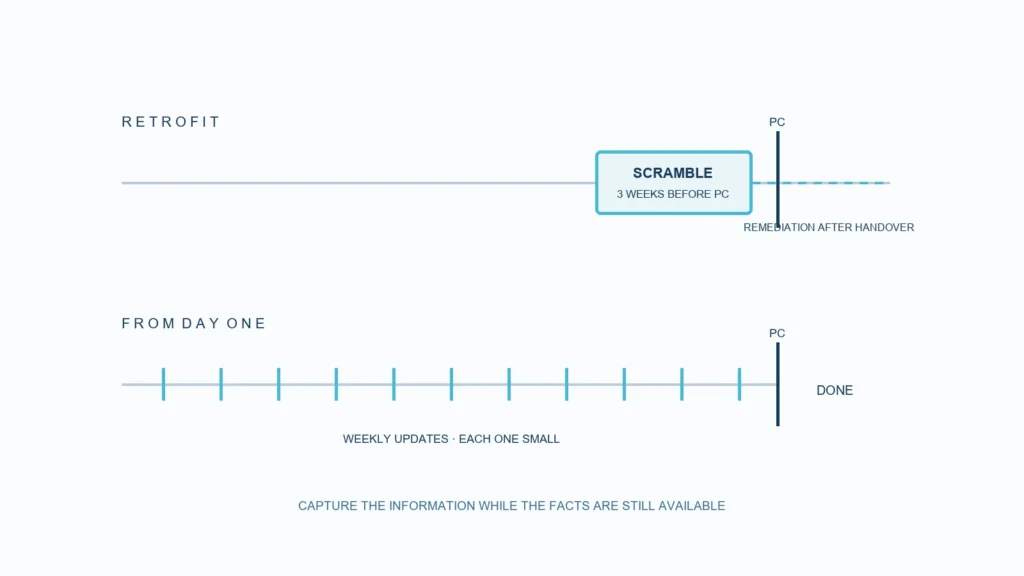
Suggested caption: The same record information can be assembled during construction or reconstructed after the facts have become harder to verify.
The retrospective route leaves most record-model activity until practical completion approaches. A concentrated update is followed by further queries and remediation after handover because gaps are discovered only when the information is reviewed as a complete set.
The progressive route uses small, repeated updates. By practical completion, the model, drawings, asset register and supporting documents have developed alongside the physical asset. Handover becomes a controlled confirmation of information already maintained, rather than a reconstruction exercise.
Keep the Model, Drawings and Data Aligned
An as-built deliverable is rarely one file. Owners may receive models, drawings, equipment schedules, asset registers, operation and maintenance documents, commissioning records, certificates and photographs.
These deliverables need consistent identifiers and revision control so users can understand how they relate to one another.
For example, an installed asset should be traceable across:
- its model element and location;
- the relevant drawing or schematic;
- its asset-register entry;
- approved product information;
- operation and maintenance documentation;
- inspection and commissioning records; and
- any warranty or compliance documentation.
Updating one surface without the others creates contradictions. A model may show the correct location while the asset register contains the wrong equipment reference, or a final drawing may reflect a change that was never incorporated into the model.
Progressive review should therefore consider the information set as a connected record, not as separate deliverables assembled by different teams.
Define What As-Built Means
The term as-built can be interpreted differently across organisations. Some teams expect verified geometry only. Others require detailed asset data, linked documents and information suitable for facilities management.
The project should define the required outcome before construction begins, including:
- which systems, spaces and assets must be recorded;
- the expected geometric accuracy and verification method;
- which properties are required for maintainable assets;
- the required naming, classification and identification rules;
- the documents and evidence linked to each asset or system;
- who produces, reviews and accepts each information set;
- the update frequency and status workflow; and
- the final file formats and operational destination.
LOD terminology may help communicate part of the requirement, but it should be supported by specific deliverables and acceptance criteria. A detailed model is not a complete as-built record if its installed condition has not been verified or its operational information is missing.
Support Handover and Future Operations
Reliable record information gives the operations team a stronger starting point. It can help users locate assets, understand system relationships, access documentation and plan maintenance without first reconstructing the building’s history.
It can also support future refurbishment, compliance reviews, space changes and digital-twin development. These uses depend on information that is structured, current and traceable.
Progressive as-built management does not guarantee that every project change will be effortless. It makes omissions visible earlier, when they are generally easier to investigate and correct.
Handover Should Confirm, Not Reconstruct
The purpose of as-built documentation is to provide a dependable record of the delivered asset. That record becomes more credible when it is maintained close to the work rather than recreated from memory near the end.
Capturing changes progressively, aligning models with documents and asset data, and assigning clear responsibility can turn handover into the completion of an established process.
An as-built model should not suddenly appear at practical completion. It should have been developing from day one.